Practical - Paper 1, Vraestel 1, Data, For the teacher
Practical - Mark sheet, Merkblad, Solutions
Theory - Question paper 2, Vraestel 2
Practical - Mark sheet, Merkblad, Solutions
Theory - Question paper 2, Vraestel 2
(I am referring to the Study Opportunities textbook.)
Practical Paper (Paper 1): 3 hours, 150 marks
WHAT TO STUDY:
· Word Processing – Section 3 (Modules 3.1 to 3.7)
· Spreadsheets – Section 4 (Modules 4.1 to 4.4)
· Presentations – only Module 5.1, but Navigation during a slide show (Pages 329 – 333) can be left out
· Integration and templates – Module 7.1
Theory Paper (Paper 2): 2 hours, 120 marks
WHAT TO STUDY:
· System Technologies and Implications – Section 1 (Modules 1.1 to 1.8)
· Network and Internet Technologies – Section 2 (Modules 2.1 to 2.5)
· Case Studies – Module 7.3
· Theory questions on practical work: ± 8 marks.
"In the countryside on The Way do not leave anything that smells, fertilizes or pollutes. Use bars, restaurants and albergues for your needs. Please keep The Way clean."


English and Afrikaans
In Module 5.1, Activity 1, Page 329 the learners are asked to add the photo Class1.jpg to the second slide. This file was accidentally omitted from the DVD provided with the teacher's guide. You can download the file from http://dl.dropbox.com/u/90712118/CLASS1.jpg
Net Afrikaans
Die PowerPoint-aanbieding vir Module 2.3 is nog gedeeltelik in Engels op die DVD. Die vertaalde weergawe is by: http://dl.dropbox.com/u/90712118/2_3%20InternetENwww%20Afr.pptx


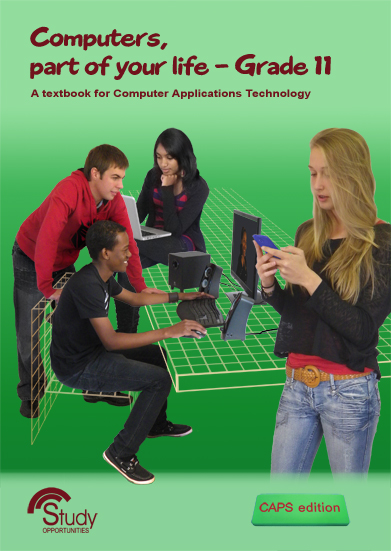 Look at the front covers of the Gr 11 CAPS book for CAT. The models look good. The contents of the book is even better.
When the Gr 10 learners get their practical question paper, they must first read it during the reading time. Then they must get a pencil and make notes on the question paper. They must look at every question and see how many 'questions' are actually asked in each numbered question. It is very easy to miss parts of a question.
One of the interesting consequences of the CAPS document is that every school has to do the same work in every term in a particular subject and grade. This means that every school can now very easily swop/buy/get quality papers, knowing that the work covered in every paper would correlate with the work which was meant to be taught, or can set their own exam papers.
I do not believe a 'single' person can set a quality paper, covering all the required content, on a meaningful theme, at the correct cognitive levels.
These thoughts came to me after perceiving the dreadful stress levels of teachers, listening to subject advisors discussing the exam requirements in their districts and the job of moderation of exam papers, and looking at the wonderful CAT papers set by Study Opportunities. In the end smart teachers must do what they have to do.
I am working with a group of students creating a survey. It is amazing how they have opinion questions where the respondents have to write text. How is the text meant to be analysed? All opinions should have responses in the form of a rating scale which one selects. If they have a scale the results can be presented in a valid graph. (But then again 80% of these students could not even create a graph when I first met them.)
Setting exam papers is a challenge, especially when time is short.
Here are some suggestions:
Firstly do not tell your learners how you are setting/getting your papers as it is actually not their business.
Set your paper on work you have done, not work you should have done.
Get reputable old exam papers from, for example, Study Opportunities, the Department of Education, etc. Take questions out of a mix of them and then adapt the theme to one common theme. If learners have seen and worked through old exam papers, some of which you have chosen in your mix, well so be it. They learned by doing the old papers which is not wrong.
Create a teacher group and set the papers together in an afternoon, all together. Keep the names of the participants in the group private so that if one teacher's learners write before another, there can be no leakages. Decide on a topic before the meeting and who will be creating the questions using particular applications and which features. Bring samples of the pre developed questions to the group meeting for putting the paper together.
Create a teacher group and plan who is going to set a particular paper during the course of the year, and divide the work load up. If one of the group does not fulfil his/her obligation, never share with them ever again, nothing!
Buy a new paper from a reputable source such as Study Opportunities if they set them that year.
Start your year with an idea or theme for an exam paper and develop it during the year. I have created some great papers when I have had time to develop them.
If you get a paper from a source, personalise it with your own header/footer and title page.
When your paper is ready, do it yourself a number of times ironing out hiccups so that when the learners get it, it is problem free.
Mark the work yourself before the time, to check your memo.
When working on a 'funny' network, do an old paper with your learners in the laboratory where they are going to work, just checking that all the required features are functioning.
There is more to life than setting exam papers. Do it smartly and save time so that you can have a life!
To insert Diacritics for the activity on page 160 try the following:
Go to Insert Symbol. Any font.
Ensure that the Edit Box (right) is set to UNICODE (hexadecimal). This will ensure that ALL symbols / characters are displayed. Look for the Venda ones in the (long) list - they are all there.
After much soul searching I returned the flash drive with 1000's of books on it. I did not take any of the books for my Kindle, although I would have loved to. I chatted to lady who had given me the flash. I was informed that many many persons had downloaded those (book) files and you can get them on the Internet. I have been so busy writing (a book) this last year that the world has passed me by and I had not heard about all the 'free' books available. It is not right! We chatted – she began to think. The e-book publishers will have to do something to curb this piracy. Read this interesting article - http://internspills.blogspot.com/2011/11/kindle-swindlers-thoughts-on-ebook.html
Piracy is not only for young people looking for music. It is now found among the book club set looking for books for their Kindles and e-book readers.
I was given a flash drive with many folders. I have been buying books to read from Amazon. I was not sure what I was looking at. The nice lady who lent me the flash suggested I copy some books onto my Kindle. On examining the flash drive, only when I found my favourite author and found titles I have bought for Xmas last year did I realise – this is piracy! I thought they were old books out of copyright!
I could not / cannot take any of these and put them on my Kindle. It is wrong. I would like to but … no!
I am amazed at how technology and the World Wide Web have changed our lives. We are now celebrating 20 years of Internet in South Africa.
I needed some particular files. I looked online, unsuccessfully. I asked for help on my Facebook page. A friend in New Zealand responded. I searched further. I contacted a firm in the US via email who recommended a software application. I went to that URL, ordered the application, paid via VISA, all on Friday 11 November. FedEx phoned me yesterday (Sunday) re paying VAT. I paid for it with Internet banking. The box was delivered this morning. Whole process took 3 days.
I am becoming used to this speed and efficiency!
I have just seen the UNESCO ICT Competency Framework for Teachers. Take a look - http://unesdoc.unesco.org/images/0021/002134/213475E.pdf Amongst the contributors are Sarietjie Musgrave (ex CAT teacher from Bloemfontein), Trudi van Wyk (ex Department of National Education), Fiona Beal (primary school teacher in Fish Hoek), Neil Butcher (consultant), Gerald Roos (consultant) and Kevin Sherman (Schools Unit at University of Cape Town) – all from South Africa. There may be more but I did not recognise their names.
My wish is that CAT teachers help the teachers at their schools upgrade their ICT skills. Give courses at your schools for teachers. My experience is that my colleagues did not come to my courses but the neighbouring school's teachers came.
Exam time in the CAT laboratory is a good time for checking the system – replace or refresh the image, check that the required features of the programs are functioning, empty the recycle bin, check that all programs are still installed, check LAN connections, etc., etc.
Exam invigilation in the CAT laboratory is a good time to look at the room and plan improvements, e.g. the layout and wall notices. Being in the room for the long invigilation sessions is a wonderful opportunity for contemplation and planning. Also walking around with a duster collecting dust (without disturbing those doing the exam) is a useful task if one needs something to do (use Wet Ones if there is not too much dirt  ).
).
The change of tempo is actually refreshing!
Hope preparation and exams go well.


