Sunday, July 8, 2012

Problem solving

Problem solving is the goal of much of the curriculum in South Africa. This PISA investigation has some of the clearest headings/labels/points I have seen for what is problem solving and how to recognise it in questions (exams). Look at pages 153 onwards. Look at marking guides on page 179. Try setting exam papers / tasks which contain problem solving questions. http://www.keepeek.com/Digital-Asset-Management/oecd/education/the-pisa-2003-assessment-framework_9789264101739-en 
My experience is that we have a long way to go in developing problem solving skills.

Computer Applications Olympiad


To prepare for the Applications Olympiad one should go over old papers.  http://www.olympiad.org.za/past-papers/programming-round-2/ This links to all old papers. Think of the prizes. Going over these old papers will assist in preparing for the Matric final examinations. No, the data is not there but the question papers are.

Sunday, July 1, 2012

2012 Computer Applications Olympiad Winners

Altogether 13 000 high school learners entered this year's CA Olympiad, doubling the 2010 figure. 
This year's Applications Olympiad finalists were very representative of the country – coming from six of the nine provinces. Unlike in the past when the Western Cape and girls dominated the Finals, this year there were no finalists from the Western Cape.
First place went to Ziyaad Seedat, a Grade 12 learner at the Ligbron Academy of Technology in Ermelo, Mpumalanga. Apart from winning a gold medal and the prestigious CoZa Cares Trophy, he also won a scholarship to the University of Cape Town, an Apple iPad and R3 000 prize money.
While most of the participants are heading for studies that will lead them into the IT world, Ziyaad is unusual in that he intends to study medicine next year – at the University of Cape Town.
Silver medals went to Salomè Bloem, a Grade 12 learner at the Hoër Volkskool in Potchefstroom, North West Province and Michael Harrison of Grade 12 at Michaelhouse in KwaZulu-Natal. Michael will study Computer Science at UCT next year, while Salomè will go to the North West University to become a chartered accountant. 
Bronze medals went to Lwandle Makhoba, a Grade 11 learner at Horizon High School in Johannesburg, Thiolan Naidoo, also a Grade 11 learner, at the Star College in Durban, and Mpumelelo Sibiya of the Ligbron Academy of Technology in Ermelo, Mpumalanga.

Article above from – https://www.facebook.com/CoZaCares 1 July


The winner Ziyaad Seedat and Fiona Wallace of CoZaCares

Congratulations to the winners! The prizes make this a worthwhile competition to enter. Just reaching the finals is an achievement. The contestants were flown to Cape Town and spent 3 nights at a guest house near the venue of the prize giving awards dinner. On the first day of the contest they answered Olympiad style questions. On the second day they were taken on a tour of the Peninsula on a Red Bus and visited the Two Oceans Aquarium and the Waterfront. That evening they attended the prize giving award dinner at Kelvin Grove.
I suggest that CAT teachers start preparing their learners now to enter this prestigious competition.  The prizes may be different next year but WOW, this year's winner really went home financially better off than when he arrived.
CAT teachers – Teach the learners to solve problems.  First make sure they can perform all the basic functions. Then focus on all the practical module activities at the end of chapters AND
  • CAPS Gr 10 book – Module 7.1 (Integrated skills) and Module 7.2 (Practical problem solving)
  • CAPS Gr 11 book - Module 8.1 (Working smarter) and Module 8.2 (Case studies)
  • Gr 11 book – Chapter 6.2 (Collaboration and integration)
  • Gr 12 book – Module 6.3 (Practice makes perfect)
  • Also go over old examination papers
Go over the work of all the grades. 
Good luck for next year!

Thursday, June 21, 2012

Gr 11 Book

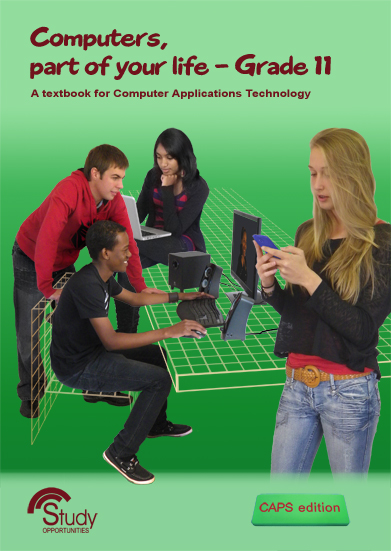
 Look at the front covers of the Gr 11 CAPS book for CAT. The models look good. The contents of the book is even better.


Wednesday, June 20, 2012

Subject choice, computational thinking and the digital divide

There is so much talk about the digital divide. The digital divide relates to the inability to access the Internet and ICT skills, and the lack of fluency in ICT skills. The digital divide impacts on education and the learners’ future in so many ways. Familiarity with computers and fluency with office applications leads to computational thinking and certain attitudes. To quote from a document from the International Society for Technology in Education and Computer Science Teachers Association 

'Computational thinking (CT) is a problem-solving process that includes (but is not limited to) the following characteristics:
  • Formulating problems in a way that enables us to use a computer and other tools to help solve them. 
  • Logically organizing and analyzing data 
  • Automating solutions through algorithmic thinking (a series of ordered steps) 
  • Identifying, analyzing, and implementing possible solutions with the goal of achieving the most efficient and effective combination of steps and resources 
  • Generalizing and transferring this problem solving process to a wide variety of problems’ 
CAT teaches these skills – using the computer to solve problems; logically organise and analyse data; automate solutions through a series of steps; and all the steps above. These skills do not only relate to computers but to life and all subject areas in the school. 

Essential attitudes / characteristics of ICT-use are
  • 'Confidence in dealing with complexity 
  •  Persistence in working with difficult problems 
  • Tolerance for ambiguity 
  • The ability to deal with open ended problems 
  • The ability to communicate and work with others to achieve a common goal or solution’ 
These are characteristics essential in today’s world. Those who do not do not become fluent with the computer do learn these attitudes / characteristics.

Look at this list – is this not what is encouraged in the activities in the Gr 10 and 11 CAPS CAT books from Study Opportunities, particularly at the end of modules and towards the back of the book. To develop computational thinking and associated attitudes the learners must learn to use the computer to solve problems.

Subject choice is taking place in many schools now. Encourage learners to take CAT or IT as in the world of expanding knowledge and changing economies learners must learn computational thinking (the problem-solving process) and develop the associated attitudes. In every school try and break the digital divide and encourage computational thinking via ICT use.

Tuesday, June 12, 2012

Videos on the Gr 10 CD-ROM

I have the pleasure of teaching a part-time B.Ed. Hons CAT class at a local university. Many of the students teach CAT. I have never told the class of my connection with a CAT textbook publisher although some may know.
Today I showed them a video on tabs emphasising how tabs should be done, with distances and temperatures, etc. Many of the students recognised the activity as coming from the Study Opportunities Gr 10 textbook.
In the discussion it became apparent that they did not know about the videos on the Gr 10 CD-ROM! They will now go and get that CD and explore it further! The videos are so good for learners and teachers to learn aspects they may not know, or so the class thought. They also thought they were good for lesson preparation.

Saturday, June 9, 2012

Gr 10 Theory Errata

The word 'with' in Question 3.3.1 should be 'without'.

Wednesday, June 6, 2012

Friday, June 1, 2012

Gr 10 Practical paper

When the Gr 10 learners get their practical question paper, they must first read it during the reading time. Then they must get a pencil and make notes on the question paper. They must look at every question and see how many 'questions' are actually asked in each numbered question. It is very easy to miss parts of a question.

Tuesday, May 29, 2012

Gr 10 June exams

June exam paper

Sunday, May 27, 2012

Setting exam papers

One of the interesting consequences of the CAPS document is that every school has to do the same work in every term in a particular subject and grade. This means that every school can now very easily swop/buy/get quality papers, knowing that the work covered in every paper would correlate with the work which was meant to be taught, or can set their own exam papers.

I do not believe a 'single' person can set a quality paper, covering all the required content, on a meaningful theme, at the correct cognitive levels.

These thoughts came to me after perceiving the dreadful stress levels of teachers, listening to subject advisors discussing the exam requirements in their districts and the job of moderation of exam papers, and looking at the wonderful CAT papers set by Study Opportunities. In the end smart teachers must do what they have to do.

Wednesday, May 23, 2012

Creating a survey/questionnaire

I am working with a group of students creating a survey. It is amazing how they have opinion questions where the respondents have to write text. How is the text meant to be analysed? All opinions should have responses in the form of a rating scale which one selects. If they have a scale the results can be presented in a valid graph. (But then again 80% of these students could not even create a graph when I first met them.)

Friday, May 18, 2012

Setting exam papers

Setting exam papers is a challenge, especially when time is short. 

Here are some suggestions:

Firstly do not tell your learners how you are setting/getting your papers as it is actually not their business.

Set your paper on work you have done, not work you should have done.

Get reputable old exam papers from, for example, Study Opportunities, the Department of Education, etc. Take questions out of a mix of them and then adapt the theme to one common theme. If learners have seen and worked through old exam papers, some of which you have chosen in your mix, well so be it. They learned by doing the old papers which is not wrong.

Create a teacher group and set the papers together in an afternoon, all together. Keep the names of the participants in the group private so that if one teacher's learners write before another, there can be no leakages. Decide on a topic before the meeting and who will be creating the questions using particular applications and which features. Bring samples of the pre developed questions to the group meeting for putting the paper together.

Create a teacher group and plan who is going to set a particular paper during the course of the year, and divide the work load up. If one of the group does not fulfil his/her obligation, never share with them ever again, nothing!

Buy a new paper from a reputable source such as Study Opportunities if they set them that year.

Start your year with an idea or theme for an exam paper and develop it during the year. I have created some great papers when I have had time to develop them.

If you get a paper from a source, personalise it with your own header/footer and title page.

When your paper is ready, do it yourself a number of times ironing out hiccups so that when the learners get it, it is problem free.

Mark the work yourself before the time, to check your memo.

When working on a 'funny' network, do an old paper with your learners in the laboratory where they are going to work, just checking that all the required features are functioning.

There is more to life than setting exam papers. Do it smartly and save time so that you can have a life!

Thursday, May 17, 2012

Access quiz on creating and formatting a report


I used this quiz when teaching formatting and selecting fields in Access reports. The students had to work in pairs doing the quiz until they achieved 100%.  Try it online or download, unzip and use on the network. Have fun. Let me know how it goes. 

Friday, April 27, 2012

Scope and length of Gr 10 CAT paper

Scope and length of Gr 10 CAT paper - plan ahead for the paper - here is what will be covered.

Wednesday, April 25, 2012

Gr 10 June papers for CAT

Gr 10 June papers for CAT:
Practical: 2.5 hours
Theory: 2 hours


Friday, April 13, 2012

Exam papers in 2012

Form to apply for Study Opportunities exam papers in 2012.

Suggestion - set the date in your school's exam timetable, spend quality time teaching and leave setting the exam papers to the experts - PM

Monday, April 2, 2012

Extract Word data and import into Excel and Access

I met a teacher who was spending some time during the Easter holidays marking the Gr 12 PATs. She mentioned that the learners had created Word forms. Here are ways in which you can extract the data from the forms and then import it into Excel or Access where you can process it. It is a large (about 20 MEG) file available in different formats for viewing and listening - mov, swf and wmv. Download (right-click on the URL, Save link as), store off line and share with your learners. Hope it is useful.

Monday, February 27, 2012

Grade 10 CAPS book - Diacritics

To insert Diacritics for the activity on page 160 try the following:

Go to Insert Symbol. Any font.
Ensure that the Edit Box (right) is set to UNICODE (hexadecimal). This will ensure that ALL symbols / characters are displayed. Look for the Venda ones in the (long) list - they are all there. 

Saturday, January 28, 2012

Digital piracy and the Kindle

After much soul searching I returned the flash drive with 1000's of books on it. I did not take any of the books for my Kindle, although I would have loved to. I chatted to lady who had given me the flash. I was informed that many many persons had downloaded those (book) files and you can get them on the Internet. I have been so busy writing (a book) this last year that the world has passed me by and I had not heard about all the 'free' books available. It is not right! We chatted – she began to think. The e-book publishers will have to do something to curb this piracy. Read this interesting article - http://internspills.blogspot.com/2011/11/kindle-swindlers-thoughts-on-ebook.html

Saturday, January 21, 2012

Piracy for the Kindle

Piracy is not only for young people looking for music. It is now found among the book club set looking for books for their Kindles and e-book readers.

I was given a flash drive with many folders. I have been buying books to read from Amazon. I was not sure what I was looking at. The nice lady who lent me the flash suggested I copy some books onto my Kindle. On examining the flash drive, only when I found my favourite author and found titles I have bought for Xmas last year did I realise – this is piracy! I thought they were old books out of copyright!

I could not / cannot take any of these and put them on my Kindle. It is wrong. I would like to but … no!

Friday, January 20, 2012

Blind learners studying computers - help please!

I recently had the pleasure of visiting a wonderful school Pioneer School for the Blind where every cent collected is used to good effect. Learners come to this school in Worcester in the Western Cape from as far away as the Free State because of what this government school has to offer. It offers a way of life for those who need special care. It is a school for the blind and partially sighted. I went to see how they learn to use the computer and study the subject Computer Applications Technology (CAT). One of the learners from this school was the top learner in the country in Matric 2011 from a special needs school and she also studied CAT.
I was shown how a partially sighted learner used the screen enlargement software Magic. That worked well. I was most disturbed when I saw a totally blind youngster use the computer! He was working with Office 2003 – with Jaws, software that reads information on the screen using synthesized speech. I asked why he was using such an old version of Office. The answer – they have licenses for an old version of Jaws which only reads 2003. They need to get a newer version of Jaws in order to read Office 2010. The CAT curriculum will require 2010 soon. They have to get up to date! They need the latest version of Jaws but it costs about R120 000 for 30 licences. And they do not have the money at the moment. They are able to get the Microsoft Office Suite at a reduced cost, the same as all government schools, and then they have this additional cost!
Computers are the way these youngsters are going to earn a living when they leave school! It would be wonderful if every computer class in South Africa had a cake sale or other fund raiser and helped these CAT learners. It would be wonderful if every person who views this blog contributed in some way. The URL of the school is http://www.blind-institute.org.za/. There is a link to do an electronic donation. Let us all donate to the school, requesting that the money be used for computer needs. Please.
It would be wonderful if you dropped me an e-mail at docpam@gmail.com to tell me if you donated and if this blog posting made any difference. This posting is from me in my personal capacity.
I believe in the idiom ‘What goes around comes around’.

Saturday, January 7, 2012

Computer Code of Conduct

We have provided a Sample Computer Code of Conduct on the DVD that comes with the Teacher’s Guide of our new Grade 10 CAT textbook. The one on the DVD has been improved and translated.
It is not possible to write any one single Code of Conduct that will serve the needs of all schools. Study Opportunities has provided this sample code of conduct as a generic example, so the document will have to be adapted to fit in with your local conditions and circumstances in your school, district and province, and to comply with any other existing regulations. You are welcome to adapt this one as you see fit and use it.

Sunday, January 1, 2012

Gr 11 CV

Grade 11s usually have to make a CV in English or Life Orientation. May I make the suggestion that CAT teachers help the learners make a good Google timeline for their digital resume.  These links may help -  http://mashable.com/2011/12/31/facebook-timeline-resume/ and  http://mashable.com/2011/09/28/facebook-timeline-cover-photo/ 
Facebook is becoming essential in today's world and in addition to the timeline, what is posted in the status bar is an important part of the digital resume. What is on the About page must also be correct and correctly spelled as well.

Thursday, December 22, 2011

Wise words


Wise words from a computer man for the world of life.

Friday, December 9, 2011

Jobs


I keep hearing about people who have lost their jobs. I heard about three more people high up in the business world recently who just lost their positions. What has this got to do with CAT - we teach ICT skills and problem solving, which may help those with entrepreneurial skills. Every functioning work station in a computer lab must have a learner and those principals who do not push CAT (because it is not a designated subject) should be ... The subject CAT can do so much to enhance job creation and business.
Walking past people begging and those living in cars is really getting to me.


Friday, December 2, 2011

Letter from Sandra

This letter is for certain schools. It contains information about invoices and payments and only applies to some schools. They know who they are.

Friday, November 18, 2011

Monday, November 14, 2011

Efficiency

I am amazed at how technology and the World Wide Web have changed our lives. We are now celebrating 20 years of Internet in South Africa.

I needed some particular files. I looked online, unsuccessfully. I asked for help on my Facebook page. A friend in New Zealand responded. I searched further. I contacted a firm in the US via email who recommended a software application. I went to that URL, ordered the application, paid via VISA, all on Friday 11 November. FedEx phoned me yesterday (Sunday) re paying VAT. I paid for it with Internet banking. The box was delivered this morning. Whole process took 3 days.

I am becoming used to this speed and efficiency!

Gr 11 Practical Paper 1 Errrata

Errata - Use the same password you used for the practical paper

Sunday, November 13, 2011

Saturday, November 12, 2011

Word form fields and Fields

A question was posed on the Comp-Studies mailing list about - a Word query where a person wants sections of text that are duplicated in a document, say in an appendix to be automatically updated if the same 'original' text is changed elsewhere.
Here is my solution in a school scenario, one is a MOV file and the other a SWF. The SWF file has a quiz attached. Comments are welcome about the videos.

Friday, November 11, 2011

ICT and teachers

I have just seen the UNESCO ICT Competency Framework for Teachers. Take a look - http://unesdoc.unesco.org/images/0021/002134/213475E.pdf Amongst the contributors are Sarietjie Musgrave (ex CAT teacher from Bloemfontein), Trudi van Wyk (ex Department of National Education), Fiona Beal (primary school teacher in Fish Hoek), Neil Butcher (consultant), Gerald Roos (consultant) and Kevin Sherman (Schools Unit at University of Cape Town) – all from South Africa. There may be more but I did not recognise their names.

My wish is that CAT teachers help the teachers at their schools upgrade their ICT skills. Give courses at your schools for teachers. My experience is that my colleagues did not come to my courses but the neighbouring school's teachers came.

Sunday, November 6, 2011

Exam time

Exam time in the CAT laboratory is a good time for checking the system – replace or refresh the image, check that the required features of the programs are functioning, empty the recycle bin, check that all programs are still installed, check LAN connections, etc., etc.

Exam invigilation in the CAT laboratory is a good time to look at the room and plan improvements, e.g. the layout and wall notices. Being in the room for the long invigilation sessions is a wonderful opportunity for contemplation and planning. Also walking around with a duster collecting dust (without disturbing those doing the exam) is a useful task if one needs something to do (use Wet Ones if there is not too much dirt ).

The change of tempo is actually refreshing!

Hope preparation and exams go well.

Wednesday, October 26, 2011

Courses offered

These grand courses are offered by UCT School Development Unit in December - Internet Basics, Google Earth for Educators and Interactive Whiteboard for Maths Teaching. Have a look.

Tuesday, October 25, 2011

2011 Final matric exam Question 7 Access

In a previous posting I indicated that one should go over old examination papers before the big exams. I will now add go over old examinations papers in the venue which will be used for the examinations. Exams have to have questions on a specific set of skills so exam papers ask those skills. So those skills should be practised in the venue where the exam will be written to check if the computers ‘can’ answer the questions (as well as checking learners’ skills). Most computers centres have some or other feature which is unique to them and although they may be re imaged before an examination, I always suggest ‘use’ the centre, test it. And after this question, I suggest practicing mail merge with different versions of Access and your version of Word.
Have a look at how to solve the question.

Friday, October 21, 2011

Laptops and mobility


Laptops are mobile and allow one to work where ever. Family men have to work but also want waves so this man has the laptop with him while waiting for the right waves. Such a good illustration.

Thursday, October 20, 2011

Examination papers

I have noticed on a number of social networking services that people are busy setting their November exam papers.  The CAT teachers could use the papers available from Study Opportunities, link http://www.studyopportunities.co.za/downloads/2011/07/EntryFormStudyOppCATPapers2011.pdf with extra information extra information at http://www.studyopportunities.co.za/downloads/2011/07/InfoPapersStudyOpp.pdf 

Comments on 2011 CAT Matric paper

One of the benefits of this blog is that you can comment Anonymously or by using your name.   
How did the examinations go? How did the September paper set by Study Opportunities help prepare learners for the final examination?
Looking forward to seeing responses.

Friday, October 14, 2011

Blackberry

Latest information for CAT learners 
 Have a smiling day

Thursday, October 13, 2011

Guide to using Email

We teach such a useful subject! This week the local librarian was telling everybody about her fear of an assessment which she will be doing this week on Email. Mmmm – about not using capital letters for the whole email, how to reply, etc. I listened and tried not to brag about what a valuable subject we were teaching at school. Have a look at the file which I used at an adult course about email.

Here is part of the file

When to use

  1. When it is necessary to send information to many people
  2. When copy of instructions is needed by the receiver and the sender
  3. When sent to a distance and it is cheaper to communicate via e-mail than voice
  4. When unable to get the person in voice contact for time or distance reasons
  5. When sending a file attachment for perusal

When not to use

  1. When emotionally responding to a message
  2. When sending confidential information

Was the file/information useful?